
Trailer Tyre Pressure Guide UK
Using the correct trailer tyre pressure is one of the simplest yet most important checks you can carry out before towing. Correct tyre pressures improve towing stability, maximise tyre life, reduce the risk of tyre failure and help keep your trailer safe on the road.
Whether you own an Ifor Williams trailer, horse trailer, car transporter or utility trailer, this guide explains how to identify the correct tyre pressure, why it matters and provides a useful trailer tyre pressure chart covering a wide range of common UK trailer tyre sizes. Regular tyre pressure checks should form part of a wider trailer maintenance routine.
Jump to section:
Quick answer: what pressure should trailer tyres be?
Most trailer tyres operate between 35 PSI and 95 PSI depending on the tyre size and specification fitted to the trailer. The correct pressure is determined by the tyre itself rather than the trailer model. Always check the tyre sidewall and manufacturer's recommendations before adjusting pressures.
- 145 R10 (P6/P7/8E): 38 PSI
- 165 R13: 65 PSI
- 175 R13: 65 PSI
- 195/60 R12: 95 PSI
- 175 R16: 70 PSI
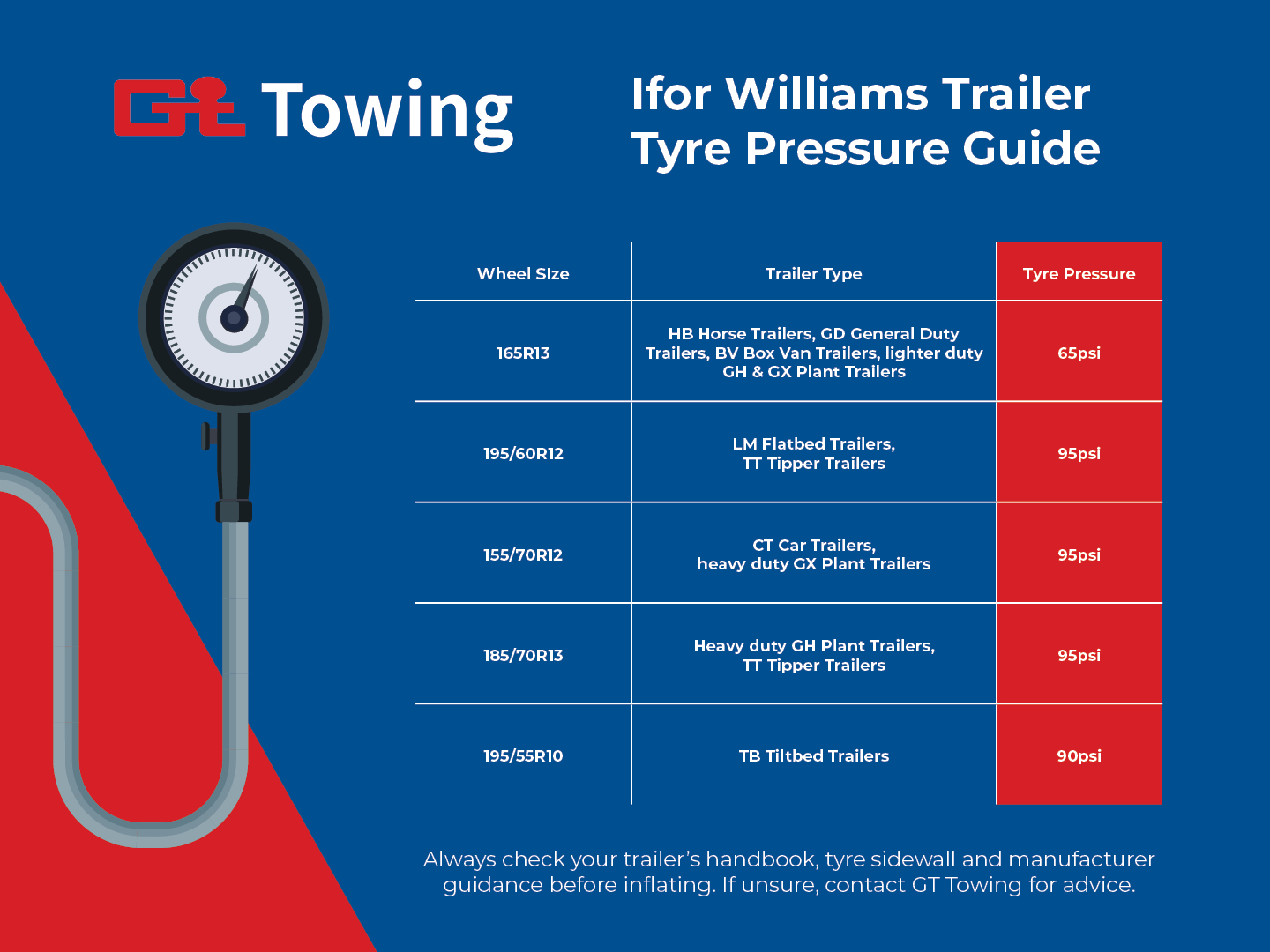
Trailer tyre pressure infographic
Use this infographic as a quick visual reference when checking your trailer tyre pressures.
Trailer tyre pressure chart
The following chart covers a range of common trailer tyre sizes and recommended pressures. These figures are intended as a guide and should always be checked against the tyre specification fitted to your trailer.
| Tyre Size | Recommended Pressure |
|---|---|
| 165 R13 | 65 PSI |
| 175 R13 | 65 PSI |
| 155 R13 | 35 PSI |
| 195/60 R12 | 95 PSI |
| 185/60 R12 | 95 PSI |
| 195/50 R13 | 95 PSI |
| 155/70 R12 | 95 PSI |
| 145 R10 (LT) | 65 PSI |
| 145 R10 (P6/P7/8E) | 38 PSI |
| 145/80 B10 | 36 PSI |
| 145/70 R13 | 46 PSI to 54 PSI |
| 20.5-10 | 36 PSI |
| 20.5-10 Heavy Duty | 70 PSI |
| 6.50 R16 | 65 PSI |
| 175 R16 | 70 PSI |
| 195/55 R10 | 90 PSI |
Common trailer tyre sizes explained
Many trailer owners search for tyre pressures by trailer model, but the most accurate way to identify the correct pressure is by checking the tyre size fitted to the trailer.
165 R13 Trailer Tyres
Typically inflated to 65 PSI. Commonly found on utility trailers and general-purpose trailers.
175 R13 Trailer Tyres
Typically inflated to 65 PSI and commonly used on medium-duty trailers.
145 R10 Trailer Tyres
Often fitted to smaller domestic trailers and some older Ifor Williams models. Depending on specification, pressures may range from 38 PSI to 65 PSI.
195/60 R12 Trailer Tyres
Typically inflated to 95 PSI and commonly used on trailers carrying heavier loads.
Why are trailer tyre pressures so high?
Many trailer owners are surprised to see recommended pressures of 65 PSI, 70 PSI or even 95 PSI. This is completely normal.
Trailer tyres are designed to carry heavy loads while remaining stable during towing. Higher pressures help support the load, reduce sidewall flex and minimise heat build-up during long journeys.
Workshop Insight
One of the most common mistakes we see is owners reducing tyre pressures because they appear higher than typical car tyre pressures. Trailer tyres are designed differently and should always be inflated to the manufacturer's recommended specification.
What happens if trailer tyres are underinflated?
- Excessive heat build-up
- Premature tyre wear
- Poor towing stability
- Reduced fuel efficiency
- Increased risk of tyre failure
Underinflation is particularly common on trailers that spend long periods parked between journeys. Tyres may appear fine externally while still being significantly below their recommended pressure.
What happens if trailer tyres are overinflated?
- Reduced grip
- Increased centre tread wear
- Harsher ride quality
- Reduced load distribution
The goal is always to run the pressure recommended for the specific tyre fitted to the trailer.
Ifor Williams trailer tyre pressures
Searches for Ifor Williams P6e tyre pressure, P7e tyre pressure, LM126 tyre pressure, TT2515 tyre pressure, HB403 tyre pressure, HB506 tyre pressure and HB511 tyre pressure are extremely common.
However, the correct tyre pressure depends on the tyre size fitted to the trailer, not solely the trailer model. The safest approach is to identify the tyre size on the tyre sidewall and match it to the pressure chart above.
Horse trailer tyre pressures
Horse trailers often spend long periods parked between journeys, making tyre pressure checks particularly important. Before transporting horses, always inspect tyre pressures, tread condition, sidewalls and wheel nuts.
Even tyres with plenty of tread can become unsafe due to age and deterioration.
How old can trailer tyres be?
One of the most common misconceptions about trailer tyres is that tread depth alone determines whether a tyre is safe to use. In reality, trailer tyres often age before they wear out.
Unlike car tyres that are used regularly, many trailers spend weeks or months parked between journeys. During this time, exposure to sunlight, changing temperatures and prolonged loading can accelerate tyre deterioration.
Workshop Insight
It is common to inspect trailers with plenty of tread remaining but visible sidewall cracking caused by age and storage conditions. Tyres can appear serviceable while still posing a safety risk.
When checking trailer tyres, inspect for cracks, bulges, perishing, uneven wear patterns and any signs of impact damage.
Why GT Towing recommends checking tyre pressures before every journey
Checking tyre pressures takes only a few minutes but can help prevent breakdowns, improve towing stability and extend tyre life.
We recommend including tyre pressures as part of every pre-tow inspection alongside lighting checks, hitch security, breakaway cable inspection and load security checks. For a complete inspection routine, see our UK Trailer Maintenance Guide.
Other trailer tyre checks worth carrying out
- Check tread depth
- Inspect sidewalls for cracks and bulges
- Check tyre age
- Check for age-related deterioration
- Inspect wheel nuts
- Look for uneven wear patterns
- Check tyre pressures before every long journey
Useful trailer resources
Frequently asked questions
How often should trailer tyre pressures be checked?
Before every long journey and after periods of storage.
Can low tyre pressure cause trailer sway?
Yes. Underinflated tyres can negatively affect trailer stability and handling.
Should trailer tyres be checked when cold?
Yes. Tyre pressures should ideally be checked before driving.
Why do trailer tyres need more pressure than car tyres?
Trailer tyres are designed to carry heavier loads and maintain stability while towing, which requires higher operating pressures.
Can trailer tyres lose pressure while parked?
Yes. Tyres naturally lose pressure over time, especially if the trailer is not used regularly.
How old can trailer tyres be?
Tyre age, storage conditions and sidewall condition are just as important as tread depth. If in doubt, have them professionally inspected.
Are trailer tyre pressures based on the trailer model?
No. The correct pressure is determined by the tyre size and specification fitted to the trailer, not simply the trailer model.
Need advice on trailer tyres or servicing?
If you're unsure whether your trailer tyres are roadworthy, our workshop team can help. We provide trailer servicing, repairs and safety inspections to keep your trailer safe and reliable.