
Choose trailer security that actually fits
Which trailer hitch lock or wheel clamp do you need? The answer depends on your trailer's coupling, its wheels and where you park it. Buying by trailer brand alone can lead to an expensive mistake, because similar trailers can have different couplings or tyre sizes.
This guide helps you identify the right security equipment, compare hitch locks and wheel clamps, understand compatibility and find suitable products from GT Towing. You'll also find photographs of different coupling types to help you identify what's fitted to your trailer.
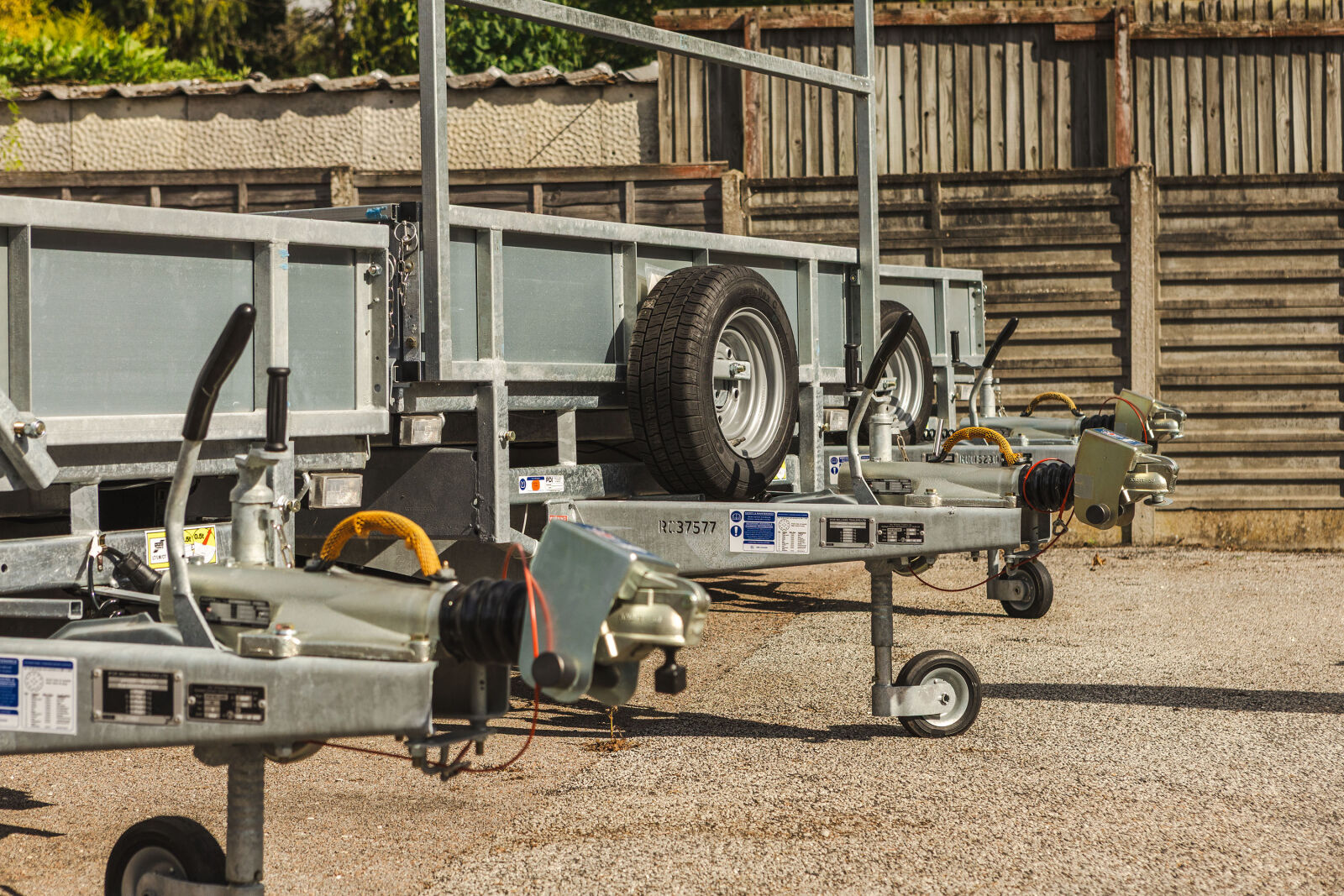
Quick answer: hitch lock, wheel clamp or both?
For a parked trailer, a compatible hitch lock and wheel clamp provide two different layers of physical security. A hitch lock helps prevent unauthorised use of the coupling, while a wheel clamp restricts movement of the wheel.
- Hitch lock: secures the trailer coupling to help prevent unauthorised hitching or uncoupling.
- Wheel clamp: restricts wheel movement and makes removing the trailer more difficult.
- Both: protect two separate points on the trailer.
- Long-term storage: consider adding a security post, ground anchor or suitable chain.
Choose a hitch lock by the exact coupling make and model. Choose a wheel clamp by the full tyre size, wheel type and fitting clearance. Always check your insurance requirements before buying, as some policies specify particular devices or security approvals.
Find the right trailer security in three steps
- Identify your coupling. Find the manufacturer and model markings on the trailer's hitch head. This determines which hitch locks are compatible.
- Check your wheels. Record the complete tyre marking and identify whether the wheel is steel or alloy.
- Consider where you park. Decide whether you need security for an unhitched trailer, one attached to a stationary vehicle or longer-term storage. Check any insurance conditions.
What's the difference between a hitch lock and a wheel clamp?
Hitch locks and wheel clamps protect different parts of your trailer. One is not a direct substitute for the other, so the best choice depends on how you use and store your trailer.
| Security device | What it does | What to check |
|---|---|---|
| Hitch lock | Helps prevent unauthorised use of the trailer coupling. | Coupling make, model and permitted fitting positions. |
| Wheel clamp | Restricts wheel movement. Some designs also cover the wheel fixings. | Tyre size, wheel construction, profile and clearance. |
| Security post | Provides a fixed barrier or hitching point at the regular parking position. | Installation, location and compatible locking arrangement. |
| Chain and ground anchor | Connects the trailer to a fixed point for additional protection. | Anchor installation, chain specification and attachment point. |
Our advice: use compatible devices that meet your security and insurance requirements, and fit them consistently. No single device guarantees that a trailer cannot be stolen.
How do I choose the right trailer hitch lock?
The most important detail is the coupling head fitted to the trailer. This is the component that connects to the vehicle's towball, rather than the towbar attached to the car.
Trailers from the same manufacturer can have different coupling heads depending on model, age and specification. A replacement coupling may also have been fitted during the trailer's life.
- Find the markings. Look for the coupling manufacturer and model reference, often stamped or cast into the metal body.
- Identify the construction. Cast and pressed steel couplings can require different hitch locks, even when made by the same manufacturer.
- Check surrounding fittings. The drawbar, handbrake, brackets and other components may affect compatibility.
- Check how the lock is used. Some can be fitted while the trailer is attached to a stationary vehicle. Others are only suitable when unhitched. Always follow the manufacturer's instructions.
What type of trailer hitch do I have?
Not sure whether your trailer has a Knott Avonride, AL-KO, Bradley or Indespension coupling? Start by comparing the shape with the examples below.
These are photographs of actual coupling heads listed on GT Towing's website, not hitch locks. They show some of the common designs you may encounter. Use the images as a visual starting point, then confirm the markings on your own coupling before choosing a security product.
Knott Avonride Cast
Example: KFG27 cast coupling head

A cast metal ball coupling used on various braked trailers, including specified Ifor Williams models.
Check: the exact Knott Avonride reference. KFG27, KFG35 and other heads are not automatically interchangeable for lock fitment.
VIEW MATCHING LOCKSAL-KO Cast
Example: AK301 cast coupling head

A cast coupling design used on compatible braked trailers and commonly associated with AL-KO AK301 and AK351 applications.
Check: whether the coupling is AK301, AK351 or another AL-KO model.
VIEW MATCHING LOCKSUnbraked Pressed Steel
Example: Ifor Williams P00355

A pressed steel hitch head used on various smaller unbraked trailers, including specified Ifor Williams P Series models.
Check: the coupling model, drawbar size, handle shape and surrounding clearance.
VIEW MATCHING LOCKSAL-KO Pressed Steel
Example: AK270 Softdock

A pressed steel AL-KO coupling design. The AK270 Softdock head has a different shape and lock application from AL-KO cast heads.
Check: the exact model, as AK270, AK300 and other AL-KO heads may require different locks.
VIEW MATCHING LOCKSBradley Doublelock Cast
Example: KIT266 Autohead

A Bradley cast coupling design found on specified trailers, including some older applications.
Check: whether you have a Bradley Autohead, Doublelock or another Bradley coupling before selecting a lock.
VIEW MATCHING LOCKSIndespension Triplelock
Example: ISCP088 cast coupling head

An Indespension cast coupling design used on compatible braked trailers.
Check: the exact Triplelock application and whether the hitch head is the version shown.
VIEW MATCHING LOCKSDon't recognise your hitch?
These six examples are only a starting point. GT Towing's full Hitch Lock Application Guide also covers other AL-KO, Bradley and Knott designs, plus towing eye applications.
Compare the photographs with your own coupling, then check the exact model reference before choosing a lock.
VIEW ALL HITCH TYPESWhich hitch lock fits an Ifor Williams trailer?
There is no single hitch lock that fits every Ifor Williams trailer. The correct lock depends on the coupling fitted, not simply whether the trailer is an HB horse trailer, GD general duty trailer, LM flatbed, TT tipper or unbraked P Series model.
For example, specified Knott Avonride cast heads can use a lock such as the Stronghold SH5415. Certain AL-KO AK301 and AK351 heads use the Stronghold SH5423, while some compatible unbraked pressed steel heads can use the SAS HL2.
Always check the actual coupling reference. Our Ifor Williams trailer data plate guide explains where to find useful model and identification information, but the coupling itself still needs checking.
Do I need a hitch lock if my coupling already has a built-in lock?
Some trailer couplings have an integral barrel lock built into the hitch mechanism. This provides a locking function, but it is not necessarily equivalent to a full external hitch lock that encloses the coupling or protects its mounting bolts.
An external hitch lock may add a more visible physical barrier and offer a separately tested security rating. Whether you need one depends on the existing coupling, how the trailer is stored and your insurance requirements.
If you are replacing or repairing an existing integral lock, browse GT Towing's insert and integral hitch locks.
Trailer hitch locks: product and compatibility examples
These products illustrate different hitch lock applications. They are not interchangeable, so always confirm the exact fit before ordering.
Knott Avonride cast couplings
Stronghold SH5415 Hitch Lock

Application: specified 50mm Knott Avonride cast coupling heads, including references 575003, 575004, 575005 and 575008.
Security: Sold Secure Caravan & Trailer Gold approval.
Check: the exact coupling reference and fitting instructions. The lock can be used on a parked trailer while hitched or unhitched, but is not recommended for use while towing.
CHECK SH5415 FIT AND PRICEAL-KO AK301 and AK351 couplings
Stronghold SH5423 Hitch Lock

Application: AL-KO AK301 and AK351 cast coupling heads.
Security: Sold Secure Caravan & Trailer Gold approval.
Check: the complete AL-KO model reference. Other AL-KO couplings may need a different hitch lock.
CHECK SH5423 FIT AND PRICECompatible unbraked trailer couplings
SAS Original HL2 Hitch Lock

Application: compatible pressed steel hitch heads fitted to single drawbars up to 60mm wide.
Examples: specified Ifor Williams unbraked P Series and BV64e trailers with the appropriate Knott pressed steel head.
Check: the coupling, drawbar dimensions and surrounding fittings. Suitable for specified parked hitched or unhitched applications, not for use while moving.
CHECK SAS HL2 FIT AND PRICESelected pressed steel couplings
Maypole MP089 Hitch Lock

Application: many compatible open handled pressed steel couplings from AL-KO, Knott, Winterhoff, Steelpress and other manufacturers.
Important exclusion: GT Towing's product listing states that this lock does not fit Ifor Williams braked trailer hitches.
Check: the exact coupling and insurance requirements. The description "universal" does not mean a lock fits every trailer.
CHECK MP089 FIT AND PRICECan't find a suitable lock in these examples? Browse the full GT Towing hitch lock range or use the Hitch Lock Application Guide to select your coupling type.
If your trailer has a towing eye rather than a standard ball coupling, browse our towing eye locks instead.
How do I choose the correct trailer wheel clamp?
Choose a wheel clamp using the full tyre size, wheel type and manufacturer's fitment information. Knowing that your trailer has a 10-inch or 13-inch wheel is not enough to confirm compatibility.
How to read your trailer tyre size
The tyre size is printed on the sidewall. For example, a marking of 165/80R13C means:
165 / 80 R13 C
- 165: nominal tyre section width in millimetres.
- 80: sidewall height expressed as 80% of the tyre width.
- R: radial construction.
- 13: wheel rim diameter in inches.
- C: commercial vehicle tyre designation.
This is not the same as the tyre's overall outside diameter. Some wheel clamp manufacturers specify both tyre width and overall diameter, so check the complete application.
Four checks before buying a wheel clamp
- Record the full tyre size. Photograph the sidewall marking, including any suffix.
- Identify the wheel type. Check whether it is steel or alloy and whether trims or projecting parts affect the fit.
- Compare the clamp's specification. Check the tyre width, overall diameter and suitable wheel profiles.
- Check clearance. Make sure there is enough space around the wheel, mudguard and any adjacent wheel to fit the clamp.
Wheel or tyre replacements can change compatibility even when the trailer itself has not changed. Check the wheels currently fitted, rather than relying on the original trailer specification.
Trailer wheel clamp examples
These products illustrate different wheel applications. They are not a complete compatibility chart for every trailer model.
Specified 165R13 wheel applications
Bulldog QD22 Wheel Clamp

Listed tyre sizes: 165R13C and 165/80R13C.
Useful feature: a centre plate covers the wheel fixings, providing an additional physical barrier.
Check: the steel wheel application, wheel profile and available fitting clearance before ordering.
CHECK QD22 FIT AND PRICESpecified 195/55R10 wheel applications
Stronghold Apex SH5450 Wheel Clamp

Application: specified 195/55R10 wheel and tyre fitments, including suitable Ifor Williams and Brian James trailers.
Security: Sold Secure Gold approval listed for the product.
Check: the actual tyre dimensions, wheel construction and fitting clearance. Confirm compatibility with GT Towing before ordering, particularly for alloy wheels.
CHECK SH5450 FIT AND PRICEHave a different tyre size? Browse the complete trailer wheel clamp range, or send GT Towing a photograph of your tyre marking and wheel for advice.
What do security ratings and insurance approval mean?
A security device can fit your trailer without necessarily meeting your insurer's requirements. Compatibility and independent security approval are two separate checks.
What is Sold Secure?
Sold Secure independently tests and certifies security products. Its Caravan & Trailer category includes approved locks and related equipment at different security grades.
Check the exact product reference and current approval in the Sold Secure Caravan & Trailer database. Approval for one model does not mean every product from the same manufacturer has the same rating.
Check your insurance requirements
Some trailer insurance policies specify approved hitch locks, wheel clamps, storage arrangements or combinations of security devices.
A product described as "insurance approved" is not automatically accepted by every insurer. Check your policy's exact requirements, fit the correct devices and retain your purchase information.
Choose equipment that both fits the trailer and meets the required level of security. It also needs to be practical enough that you will use it every time the trailer is left unattended.
How should I secure a trailer at home or in storage?
For longer-term parking, consider the trailer and its storage location together. A suitable hitch lock and wheel clamp can be supplemented by a locked gate, security post, chain or ground anchor.
Bulldog SA7L Removable Security Hitch Post

A removable security post with a hitching point for a suitable trailer and compatible locking arrangement.
Best suited to: a regular trailer parking position where a fixed security point is practical.
Check: positioning, ground installation and compatibility with the intended hitch lock.
VIEW THE SA7L SECURITY POSTBulldog MC30 Chain, Padlock and Ground Anchor

A ground anchor kit with a 1.5m chain, 10mm links and a padlock, designed to provide an additional fixed security point.
Best suited to: a driveway, yard or secure storage area where permanent anchoring is possible.
Check: anchor installation, chain reach and the trailer attachment point.
VIEW THE MC30 ANCHOR KITFor other options, browse chains, cables and padlocks or explore the complete trailer security range.
Simple trailer security checklist
- Fit your chosen security devices correctly whenever you leave the trailer unattended.
- Use a secure parking position, locked gate or suitable physical barrier where possible.
- Keep a record of the trailer's make, model and serial number.
- Take photographs of the trailer and identifying markings.
- Consider an alarm or tracker as an additional measure, rather than a substitute for physical security.
- Inspect locks for wear, damage and corrosion, and store keys safely.
- Check that your arrangements meet any insurance requirements.
Before towing: remove wheel clamps, security chains and any devices that prevent movement or are not approved for road use. A hitch lock that can be fitted while the trailer is attached to a stationary vehicle is not necessarily safe to leave fitted while towing. Follow the manufacturer's instructions and complete your normal trailer safety checks.
Trailer hitch lock and wheel clamp FAQs
Is a hitch lock or wheel clamp better?
They protect different parts of the trailer. A hitch lock secures the coupling, while a wheel clamp restricts wheel movement. Using compatible devices together provides two separate physical barriers.
How do I identify my trailer coupling?
Look for the manufacturer and model markings on the coupling head, then compare its shape with the photographs in this guide. Check whether the coupling is cast or pressed steel. If you are unsure, send GT Towing clear photographs of the head and its markings before ordering a lock.
Which hitch lock fits an Ifor Williams trailer?
It depends on the coupling head fitted. Ifor Williams trailers can use Knott Avonride, AL-KO and other coupling types depending on model and age. Use the Hitch Lock Application Guide and confirm the actual coupling reference before buying.
Will a universal hitch lock fit every trailer?
No. Universal hitch locks fit a range of specified couplings, not every coupling. Some have important exclusions. Always check the application list for the exact product.
Do I need an external hitch lock if I have a barrel lock?
A built-in barrel lock can provide basic coupling security, but an external hitch lock may add a more substantial physical barrier. Whether you need one depends on your existing coupling, storage arrangement and insurance requirements.
Can a hitch lock stay fitted while towing?
Only if the manufacturer explicitly approves that use. Many hitch locks can be fitted while a trailer is attached to a stationary vehicle but must be removed before towing. Follow the instructions for your exact lock.
How do I know which wheel clamp size I need?
Check the full tyre marking on the sidewall, the wheel construction and the clamp manufacturer's fitment information. Tyre width, overall diameter and clearance can all affect compatibility.
Will a wheel clamp fit alloy wheels?
Some wheel clamps are suitable for specified alloy wheel applications, while others are intended for steel wheels only. Check the manufacturer's specification for the exact wheel and tyre combination before ordering.
Do I need both a hitch lock and wheel clamp for insurance?
This depends on your insurer and policy. Some policies specify one approved device, while others require particular combinations or storage arrangements. Confirm the exact conditions before purchasing security equipment.
Does Sold Secure approval guarantee insurance acceptance?
No. Sold Secure approval identifies a tested security category and grade. Your insurer may have additional requirements for the device, its installation or the way the trailer is stored.
Not sure which lock fits your trailer?
GT Towing can help you narrow down suitable products before you order. Email photographs of your coupling or wheels to sales@gttowing.co.uk, or call 01707 26 25 26.
For hitch locks, include a photograph of the coupling from above and from the side, showing any markings. For wheel clamps, include the complete tyre size, wheel type and available clearance.
GT Towing is based on the Great North Road, Welham Green, near Hatfield, Hertfordshire, AL9 5SD.
More useful trailer resources
For further help with trailer ownership and maintenance, explore our trailer tyre pressure guide, trailer maintenance guide, hitching and unhitching guide and information and resources library.
Product and technical information: Compatibility guidance is based on GT Towing's product listings, coupling examples and relevant manufacturer specifications. For independent security approvals, consult the Sold Secure Caravan & Trailer database. Additional trailer security guidance is available from Secured by Design.
Last reviewed: . Product specifications, availability and security approvals can change. Confirm the exact coupling, wheel fitment and insurance requirements before buying.