
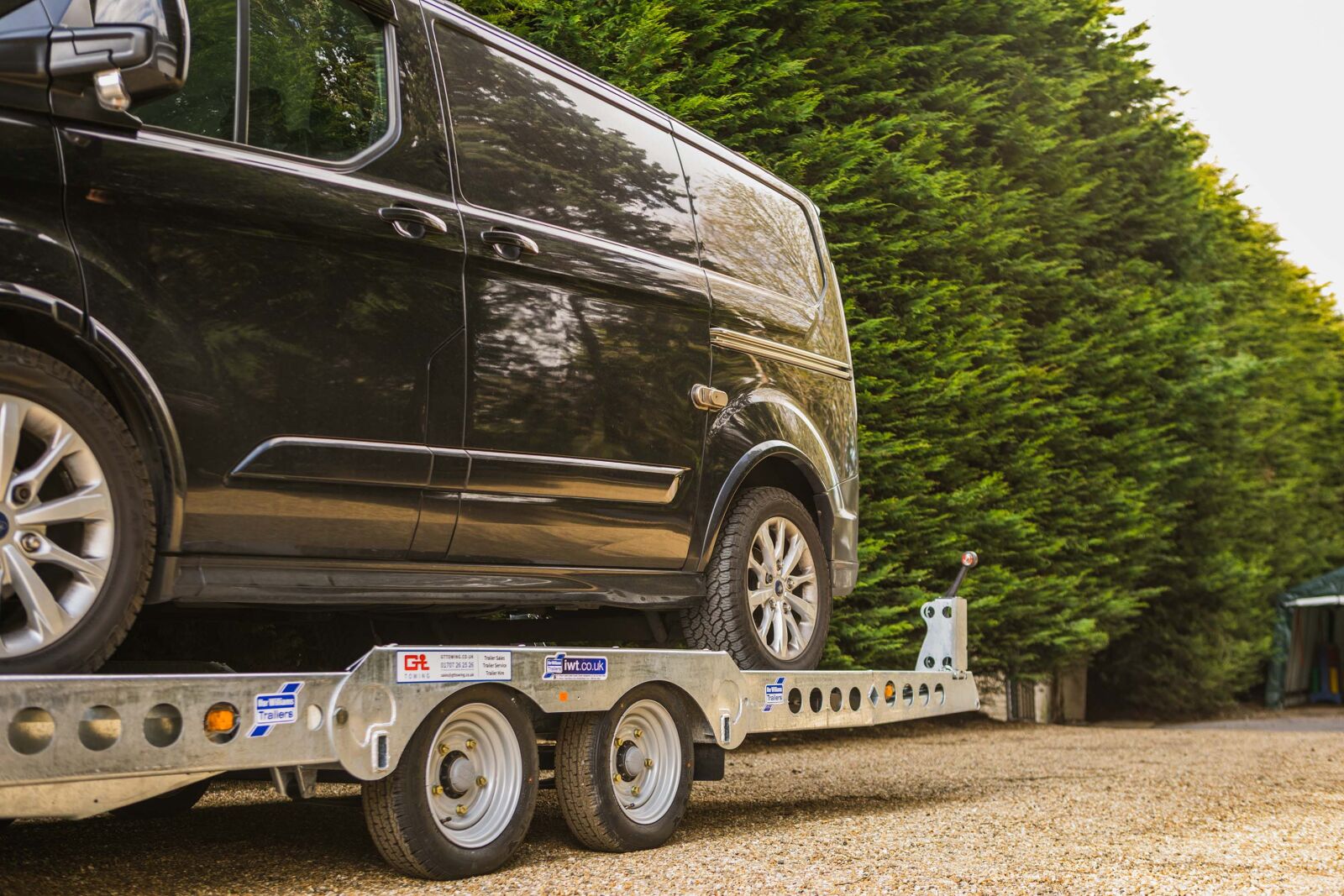
A car transporter can be long enough for your car and still be the wrong trailer. The wheels might not fit between the mudguards, the front bumper might catch on the ramps, or the loaded trailer might exceed your towing vehicle's limit.
Whether you are collecting a project car, taking a vehicle to a track day or choosing a transporter for regular work, start with usable space, payload and loading clearance. This guide explains what to measure and compares real options available from GT Towing.
What size car transporter trailer do I need?
Choose a trailer with enough usable deck length and width for your car, enough payload for its actual weight and a loading arrangement that clears its bodywork. The weight of the trailer and everything on it must also stay within your towing vehicle's limits.
GT's hire examples range from a 3.3m × 1.7m compact transporter to a 5.5m × 2.22m tilt bed. Treat those dimensions as a shortlist, not a guarantee that a particular car fits.
Car transporter trailer sizes compared
The table below uses examples from GT Towing's car transporter hire fleet. Bed size is the advertised loading area, not the trailer's overall dimensions. Payload is the load it can carry; maximum gross weight includes the trailer itself.
| Hire trailer | Bed length × width | Maximum gross weight | Listed payload | Loading arrangement |
|---|---|---|---|---|
| Compact Brian James CT1 | 3.3m × 1.7m | 2,000kg | 1,400kg | Ramps and manual winch |
| Small / medium Brian James CT3 | 4.0m × 1.8m | 2,600kg | Confirm before booking* | Ramps and manual winch |
| Medium / large Brian James CT5 | 5.0m × 2.0m | 3,000kg | 2,300kg | Ramps and manual winch |
| Large Brian James tilt bed CT10 | 5.5m × 2.22m | 3,500kg | 2,500kg | Hydraulic tilt, ramps and manual winch |
*Confirm the CT3 payload with GT Towing before booking. For every option, check the specification and equipment of the actual trailer supplied. CT1, CT3, CT5 and CT10 are GT hire references, not interchangeable manufacturer model codes.
A compact trailer may be enough for a small, light car. A larger car may need more width, payload or both. Moving up to the longest trailer does not automatically solve every fit problem, particularly with low bodywork or restricted mudguard clearance.
Compare car transporter hire options
What should you measure before choosing a car trailer?
Use specifications for the exact model and version, then check the vehicle itself. Modified wheels, body kits, suspension and accessories can change what will fit safely.
1. Length, wheelbase and positioning room
Record the car's overall length and wheelbase, which is the distance between its front and rear axles. Its tyres must sit on the trailer's intended load bearing areas, with enough room to position the car for correct weight distribution and attach the straps.
Do not assume the wheelbase alone proves compatibility. Bumpers and overhangs also need clearance from the front equipment, rear lights and other parts of the trailer.
2. Body width, tyre width and mudguards
Check body width, width across the outside edges of the tyres and mirror clearance separately. The trailer's overall width is not the same as the space between its mudguards. Door opening clearance also matters if someone must get out after loading the car.
A wider quoted bed does not always mean more body clearance
The Ifor Williams CT177 listing gives 1.89m inside its drive over mudguards and 2.20m outside them for suitable commercial vehicle applications. That wider figure is not a clear passage for every low car.
GT's CT17 hire listing specifically excludes low slung vehicles wider than 1.9m. Confirm the car's bodywork clearance rather than relying on the headline width.
3. Ground clearance and overhangs
Measure the lowest parts of the car, including spoilers, exhausts and side skirts. Consider the front overhang and the point where the ramps meet the deck: a car can clear the initial approach but still ground as it reaches the bed.
4. Actual transport weight
Find the weight of the car as it will be transported, including fuel, modifications and anything carried inside. Published kerb weight is a starting point, not proof of the actual load. Use a reliable weighing method where the weight is uncertain or close to a limit.
How much weight can a car transporter actually carry?
A 3,500kg car transporter cannot necessarily carry a 3,500kg car. The maximum gross weight includes the trailer itself, its fitted equipment and the load.
- Maximum gross weight / MAM
- The maximum permitted total weight of the loaded trailer.
- Empty trailer weight
- The trailer's weight before loading the car. Account for the ramps, winch, spare wheel and other equipment actually fitted or carried.
- Payload
- The remaining capacity for the car and any additional load. Accessories reduce available payload unless already included in the stated empty weight.
Worked example: the trailer fits, but the towing vehicle does not
Illustrative figures, not the specification of a particular hire trailer.
| Trailer maximum gross weight | 3,000kg |
|---|---|
| Empty trailer, including its fitted equipment | 700kg |
| Available payload | 3,000 − 700 = 2,300kg |
| Car plus additional equipment | 1,850 + 50 = 1,900kg |
| Actual loaded trailer weight | 700 + 1,900 = 2,600kg |
The load is within the trailer's 2,300kg payload, but a towing vehicle limited to 2,500kg cannot tow this 2,600kg loaded trailer. Passing the trailer's payload check does not mean you have passed the towing vehicle check.
Check the tow vehicle as well as the trailer
Confirm the vehicle manufacturer's braked towing limit, gross train weight and vehicle and axle limits. Gross train weight covers the towing vehicle and loaded trailer together, so passengers, fuel and luggage in the tow vehicle also matter. Check towbar, coupling and permitted nose weight limits, plus your licence entitlement.
Do not move the car to an unsuitable position simply to make a dimension fit. The loading position must produce appropriate nose weight and axle loads without exceeding any rating. Use the manufacturer's instructions and measurements, not whether the combination merely looks level.
Read our towing weight guide alongside the current GOV.UK towing limits and your vehicle and trailer handbooks.
Do you need ramps or a tilt bed transporter?
Size is only useful if the car can get onto the trailer without damage. A low sports car, long front overhang or modified suspension can make the loading arrangement just as important as deck length.


A fixed bed with suitable ramps may be sufficient where the car clears the approach and ramp to deck transition. A tilt bed changes the loading geometry and can help with low clearance, but does not guarantee that every lowered car fits.
Ask about ramp length, width, load rating and attachment method as well as bed height. Tell GT about splitters or low exhausts before booking. Do not improvise extra ramps or supports without approval for the specific setup.
What if the car does not run?
A winch may help load a car that cannot drive under its own power, but first confirm that it rolls, steers and can be loaded in a controlled way. Seized brakes, missing wheels or accident damage need assessment before choosing a normal hire trailer.
Tell GT whether the car starts, rolls and steers, and provide photographs of any damage or clearance problem. A winch is not a substitute for the straps securing the car during transport.
Leave room to secure the car, not just park it
A car that only just squeezes onto the deck can leave poor access to its wheels and the trailer's attachment points. Check you can fit suitable wheel straps and reach the ratchets without trapping webbing against bodywork or sharp edges.
Use the trailer's approved securing arrangement and suitable rated attachment points. For recovery transporter trailers, DVSA guidance requires all four wheels to be secured; a winch cable does not replace the securing system.

Check your straps before the journey
Our car and van strapping guide includes a practical video. Check strap condition, fit and the instructions for both the trailer and the vehicle being carried.
GT's CT1, CT3, CT5 and CT10 hire listings include four ratchet straps. Confirm what comes with your booking before buying additional equipment. Before departure, also check coupling, breakaway cable, tyres, lights, number plate and load security using our trailer maintenance guide.
Should you hire or buy a car transporter trailer?
For an occasional collection, hiring lets you choose around that particular car. For repeated use, compare the vehicles you expect to carry, storage space and equipment costs before deciding what to buy.
Hiring from GT Towing
Use the car transporter hire range to check availability and prices for your dates. Bookings are made online, with collection and return at GT Towing in Welham Green near Hatfield. Hire trailers are not available for delivery.
Check the chosen trailer's collection times, required documents, insurance conditions and registration plate arrangements. Contact GT for sizing advice before booking, rather than assuming the largest available trailer is the answer.
Buying: compare usable space and payload
These two Ifor Williams models show why both dimensions and weight matter. They are purchase options, not the same specifications as the Brian James hire examples listed above.
Ifor Williams CT136HD

Internal bed: 4.00m × 1.84m.
Maximum gross weight: 2,600kg.
Listed payload: 2,090kg.
A compact option to assess where its deck dimensions and loading ramps suit the car. Check the cost and weight of any optional winch, decking or other equipment.
View CT136HD specificationsIfor Williams CT178

Bed length: 5.00m.
Width inside mudguards: 2.08m.
Maximum gross weight: 3,500kg.
Listed payload: 2,670kg.
A wider hydraulic tilt bed option. The separate 2.39m outside mudguard dimension is for suitable commercial applications, not unrestricted clearance for every car.
View CT178 specificationsSpecialist car transporter for low vehicles
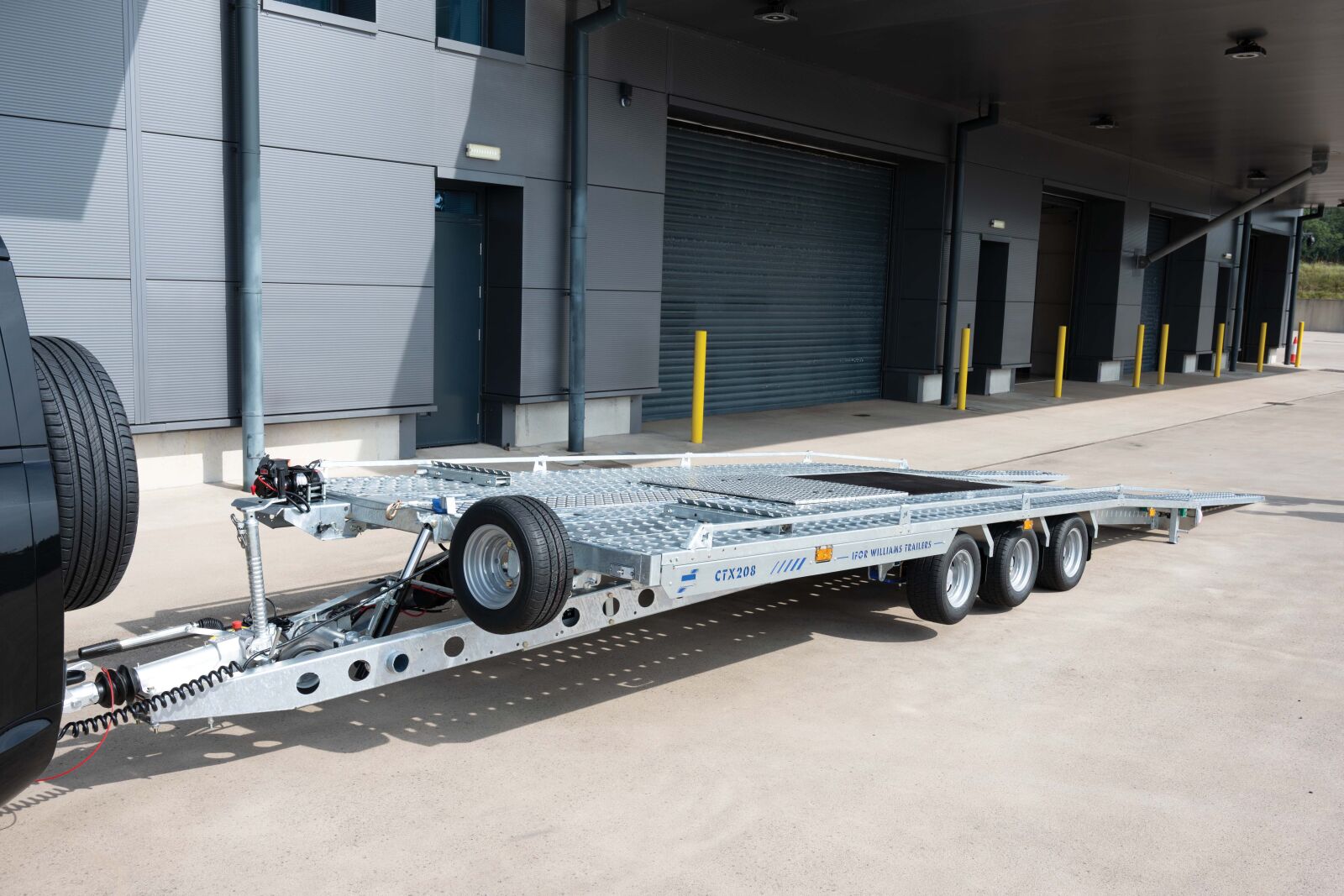
New Ifor Williams CTX208: designed for low cars and supercars
For low sports cars, prestige vehicles and professional transport, the new Ifor Williams CTX208 is an exciting option. Its low bed and hydraulic tilt can create a loading angle as shallow as 5 degrees when fully tilted, helping reduce the risk of front splitters and other low bodywork contacting the ramps.
5°
Minimum quoted loading angle when fully tilted
6.04m
Loading bed length, with up to 2.30m width
2,510kg
Maximum quoted payload in standard configuration
It has a 3,500kg maximum gross weight, a low 530mm unladen bed height and adjustable ramp positions to suit different track widths. The bed is 2.30m wide without side rails or 2.24m with side rails. Manual hydraulic tilt is standard, with electric tilt and longer 2.4m ramps available as options.
The 2,510kg payload assumes manual hydraulic tilt, 1.8m ramps and no additional accessories. Optional equipment reduces available payload. A shallow loading angle helps, but you must still check the actual car's clearance, dimensions and weight. The CTX208 is a purchase option, not one of the hire trailers compared above.
Published payloads depend on specification and fitted equipment. Product photographs may show optional extras. Confirm the exact trailer before ordering or planning a load.
The CT177 is another option where its narrower bed suits your vehicles. GT also offers long term Ifor Williams car trailer hire for customers considering an alternative to purchase.
Car transporter sizing questions
Is a 16ft car trailer big enough?
Length alone cannot confirm a fit. Check usable width, payload, wheelbase, body clearance and loading angle as well. GT's 5.0m × 2.0m CT5 hire trailer is a useful size to compare, but its listed 2,300kg payload still has to suit the actual vehicle weight.
Can a car be longer than the trailer bed?
Some configurations accommodate body overhang, but the tyres must remain properly supported and the car must be positioned and secured correctly. Check the trailer manufacturer's instructions, clearance from fittings, visibility of lights and number plates, and applicable load projection rules. Do not assume a longer car is acceptable because its wheels fit.
Can I carry an electric car, SUV or van?
Possibly, but check the exact version's actual weight and dimensions. A large bed does not guarantee enough payload. Vans carrying tools or stock and heavier vehicle variants may need a different transporter or professional vehicle transport service. Tell GT the full vehicle details before making a booking.
Does a 3,500kg trailer mean my car can tow it?
No. The plate gives the trailer's maximum permitted loaded weight, not your vehicle's towing capability. Check actual loaded weight, the vehicle's towing and train limits, axle and nose weight limits and your licence entitlement. Consult GOV.UK licence guidance; the rules described there apply to Great Britain, with separate arrangements in Northern Ireland.
Is a bigger trailer always safer?
No. A larger trailer may provide useful clearance but can also add weight and require more space to manoeuvre or store. Choose one that meets the car's requirements and the towing vehicle's limits, rather than selecting by size or axle count alone.
Not sure which transporter fits your car?
Send GT Towing the details below and we can help narrow down suitable options before you buy or book.
- The car's make, model, year and exact version.
- Its actual weight, length, width and any low bodywork or modifications.
- Whether it starts, rolls and steers.
- Your towing vehicle and its verified towing limits.
- Your hire dates or the vehicles you expect to carry regularly.
Email sales@gttowing.co.uk or call 01707 26 25 26. Photographs help with clearance questions. GT Towing is on the Great North Road, Welham Green, near Hatfield, Hertfordshire, AL9 5SD.
We can advise by phone or email; hire bookings must be completed online.
Sources and specifications: trailer dimensions and capacities are taken from the GT Towing product listings linked beside each example. Loading features are also described by Ifor Williams. Safety guidance draws on GOV.UK towing safety checks and DVSA vehicle load securing guidance.
Information checked: . Specifications and availability can change. This guide helps you shortlist a trailer; it does not replace the instructions and limits for your exact vehicle and trailer.